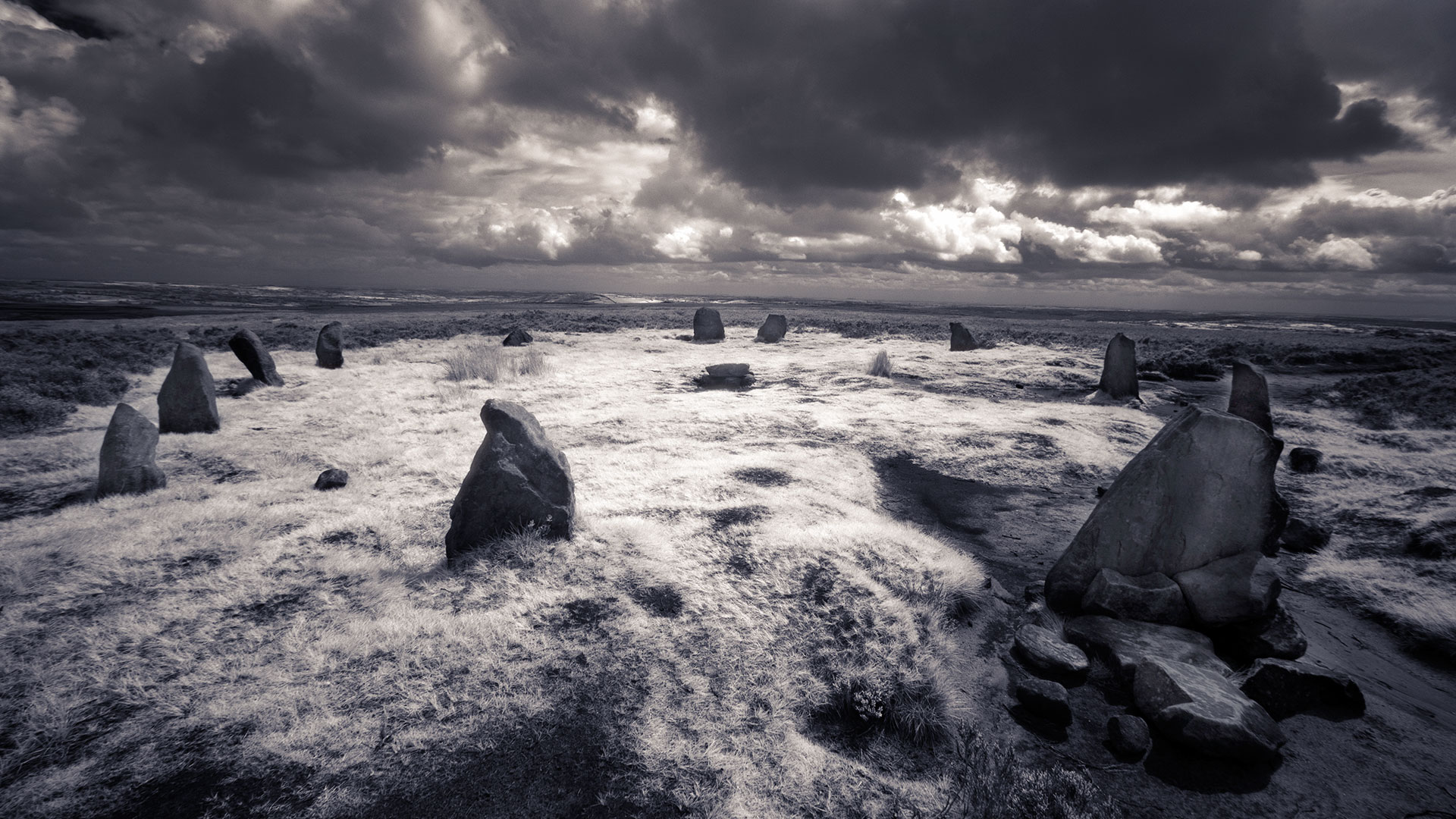
THE TWELVE APOSTLES
The air on the moor is thick enough to drink. It is a brew of peat, damp heather, and something else, something electric and ancient. To walk up onto Ilkley Moor on a thundery summer’s afternoon is to feel the landscape holding its breath. The path, a dark score through the purple-green expanse, is a line of memory, trodden by millennia of feet. Ahead, under a sky the colour of a bruise, the goal is a scattering of rock, a whisper of deep time made solid: the Twelve Apostles.
They are not apostles, of course, and there are not twelve. The name is a later fancy, a Christian gloss on a pagan syntax. They are gritstone, rough-toothed and stubborn, a circle of megaliths sunk into the high, lonely ground of the moor. To reach them is to feel the gradient in your calves and the rising pressure in the atmosphere. The stones are low, hunched against the wind, their surfaces a cartography of lichen and erosion. They do not command the landscape like a cathedral; they are part of its weave, as much a feature of this place as the bracken and the dark, peaty water that seeps from the soil.
As I stand within the circle, the sky finally breaks its silence. A low, guttural rumble rolls in from the west, a sound that seems to come from the earth itself. The first drop of rain is fat and cold, a sudden shock on the skin. Then more, speckling the dark faces of the stones, releasing a sharp, ozonic scent from the dust and the dry heather. The world shrinks to the circumference of the circle and the immense, shifting canopy of the storm. A flicker of lightning illuminates the moor for a half-second, bleaching the colour from the world, and in that instant, the stones are stark silhouettes against the glare, their long shadows leaping and vanishing.
There is no shelter here. To be among the Apostles in a storm is to feel a profound exposure, but also a strange rootedness. These stones have stood through countless such tempests. They have felt the sun and the frost, the scouring wind and the lashing rain. They are anchors in the flux, silent witnesses to the sky’s brief rage. The thunder cracks directly overhead now, a violent tearing of the air, and the rain falls in a solid, hissing sheet. I am pinned to the earth with the stones, feeling the pulse of the storm, a fleeting creature of flesh and bone in a place that measures time in geological epochs. The storm will pass, as all storms do, but the stones will remain, holding the memory of the thunder in their silent, patient hearts.