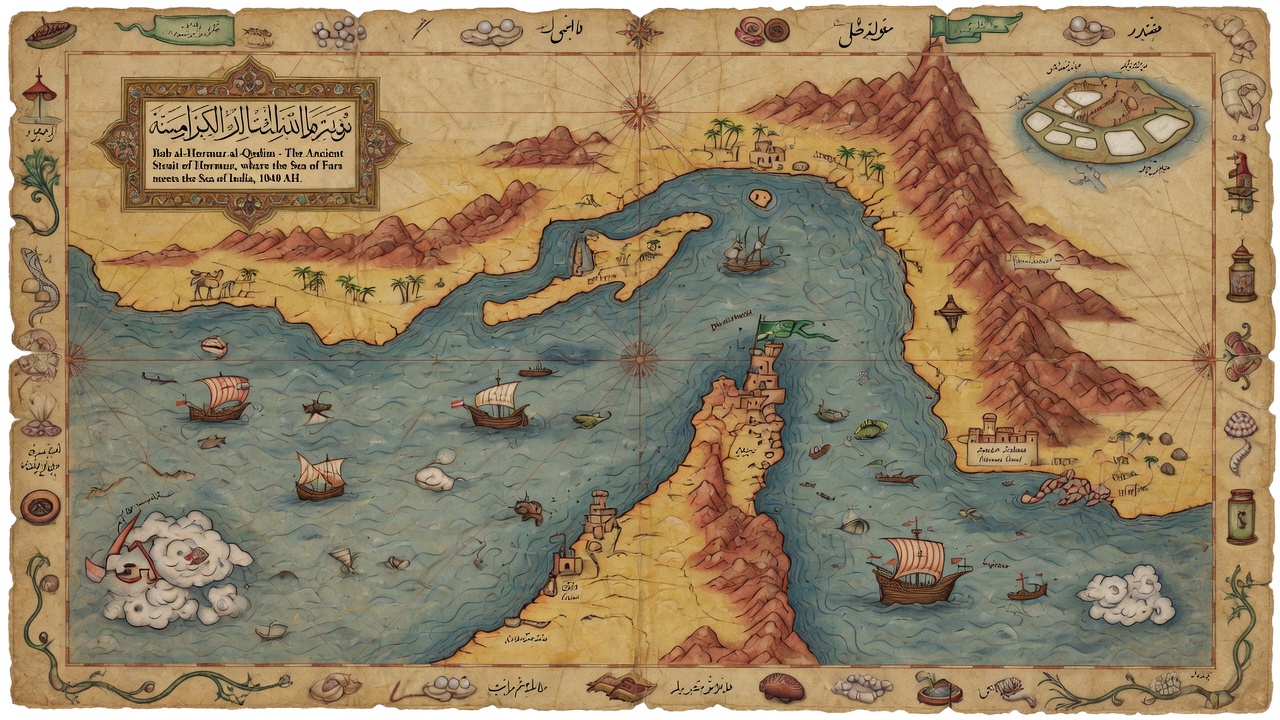
The Strait of Hormuz is twenty-one miles wide at its narrowest point, which is simultaneously a very short distance and an impossibly vast one, depending on whether you are measuring it with a surveyor's chain or with human anxiety. Twenty-one miles. A fit person could walk it in about seven hours, assuming they had mastered the considerably more difficult trick of walking on water, which humanity had thus far managed exactly once and had been arguing about the details ever since.
Ships, being rather more practically minded than religious scholars, simply sailed through it, carrying approximately twenty percent of the world's petroleum, which is to say, carrying the distilled remains of creatures who had died millions of years ago and who would have been very surprised to learn that their decomposed bodies would one day form the basis of an economic system complex enough to make the average medieval theologian weep with confused admiration.
The Strait had existed for rather a long time before humanity came along and decided it was important. The water had been water. The shores had been shores. Fish had swum through without filing the appropriate documentation or pausing to consider the geopolitical implications of their migration patterns. It was only when humans invented the concept of *yours* and *mine* and, rather more fatally, *ours* that the Strait began to mean something beyond its simple geography.
This is the thing about belief, you see. It can take twenty-one miles of water and transform it into something that keeps admirals awake at night and makes economists speak in hushed, reverent tones about "chokepoints," which is exactly the sort of word that sounds like it belongs in a medical textbook rather than a discussion of international commerce. The economists are particularly fond of it because it suggests something organic and inevitable, as though the global economy were a living creature with a throat that could be squeezed, rather than an elaborate game of shared pretending that only works because everyone has agreed, mostly, to keep pretending together.
The humans who lived around the Strait had believed many things over the millennia. They had believed in gods who lived in the water and gods who lived in the sky and gods who lived in the spaces between things, which is where most gods prefer to live, when you think about it, because the spaces between things are rather difficult to investigate empirically. They had believed that the sun was a chariot, and then that it was a ball of fire, and then that it was a nuclear furnace, each belief arriving with absolute certainty and departing with considerable embarrassment. The embarrassment, it should be noted, was never quite embarrassing enough to make anyone more cautious about the next absolute certainty, which is one of humanity's more endearing and terrifying qualities.
And now, in what humanity had somewhat optimistically termed the modern era, they believed in something far more powerful and far more demanding than any god: they believed in the economy.
The economy, unlike most deities, did not require temples. It required terminals. It did not ask for sacrifices of goats or grain. It asked for sacrifices of rather more abstract things: stability, certainty, the quiet sleep of shipping insurers. And unlike most gods, the economy was not content to remain in the heavens or the underworld or the spaces between. The economy was *here*, in the twenty-one miles of water where tankers the size of small villages sailed with bellies full of black liquid that had once been plankton, back when plankton had the good sense not to be valuable.
There is a certain kind of man who believes that belief itself is a weapon, and that if you believe something loudly enough, with sufficient conviction and the right quality of hair, the universe will simply rearrange itself to accommodate you.
This is not, it should be noted, an entirely unreasonable position. The universe, after all, has no particular opinion about anything. It does not care whether oil flows east or west. It does not concern itself with tariffs or treaties or the wounded pride of nations. The universe, in fact, is rather remarkably indifferent to everything except the laws of physics, and even those it enforces with the bored efficiency of a bureaucrat who has been doing the same job since the beginning of time, which is of course exactly what it has been doing.
But here is the thing that such men consistently fail to understand: the universe's indifference is not the same as malleability. You can believe very firmly that gravity does not apply to you, and gravity will continue to apply to you regardless. You can announce with tremendous confidence that trade wars are easy to win, and the Strait of Hormuz will continue to be twenty-one miles wide and absolutely essential to the functioning of an industrial civilization that runs on dead plankton.
This kind of man—and it is almost always a man, for reasons that anthropologists debate and comedians merely observe—tends to see the world as a construction of confidence. He believes that reality is whatever you can convince people it is, which is true in the same way that a soap bubble is true: perfectly real, beautifully iridescent, and liable to pop with very little warning. The problem with soap bubbles, from a strategic perspective, is that they do not give you advance notice of their popping, and they are entirely unwilling to negotiate about the timing.
He looks at the Strait of Hormuz and sees not geography but leverage. He looks at the ships and sees not the accumulated engineering genius of centuries but chips in a very large and very high-stakes game of poker. He believes, with the sort of faith that would embarrass most religious devotees, that everything is negotiable, that every crisis is a opportunity misspelled, and that the world exists primarily as a stage upon which he might demonstrate his own magnificence.
The Strait, for its part, continues to not care. Water is good at that.
The interesting thing about chokepoints is that they work in both directions.
This is something that strategists understand and that believers in pure will tend to forget. The Strait of Hormuz is not merely a place through which oil flows *to* the industrialized world; it is a place through which everything flows *to* everyone. Close it, and you do not simply inconvenience your enemies. You inconvenience your friends, your enemies' friends, your friends' enemies, and the extremely complicated category of people who are your enemies when it is economically advantageous and your friends when it is not, which is to say, nearly everyone.
The modern world, for all its talk of independence and sovereignty and national greatness, is connected by threads of trade so numerous and so fine that no one person can possibly understand them all. A ship that leaves the Strait might carry oil that will be refined into gasoline that will power trucks that will deliver components that will be assembled into phones that will be used to post opinions about how trade should be conducted by people who understand none of this and who become very upset when you point this out.
Belief, in such a system, is both irrelevant and essential. The oil does not flow because people believe in it; it flows because of pumps and tankers and the remarkably banal logistics of international commerce. But the *system* runs on belief—belief that contracts will be honored, that currencies will hold their value, that the ships will not be seized or the strait will not be closed or the whole delicate apparatus will not come crashing down because someone, somewhere, decided to prove a point.
This is the secret that the powerful rarely understand and the truly powerful never forget: you can break anything, but you cannot always put it back together, and the pleasure of breaking is usually rather shorter than the consequences.
There was a certain king, once, in a land not so very far from the Strait, who believed that he could control the sea.
The story goes that he ordered his soldiers to whip the waves as punishment for destroying his bridge, which is exactly the sort of thing that sounds like madness until you realize that he was not actually trying to discipline the water. He was trying to demonstrate to his army, and to history, that nothing was beyond his will—not even the ocean itself. It was a performance, in other words. A display of belief so absolute that it crossed over into absurdity and out the other side into something like propaganda.
The waves, naturally, did not care. They continued to wave, which is what waves do, regardless of whether they are being whipped, flattered, or ignored entirely. The king got his bridge rebuilt, eventually, because that is what engineers do when you pay them enough and execute enough of the ones who fail. And history recorded the whipping as either madness or genius, depending on who was doing the recording and what point they were trying to make.
The thing is, belief can move armies. It can launch ships and topple governments and convince millions of people to buy things they do not need with money they do not have. Belief is, in its way, the most powerful force in human affairs, because human affairs are conducted entirely by humans, who are nothing if not credulous.
But belief cannot widen a strait. It cannot create oil where there is none. It cannot make the laws of supply and demand suspend themselves for the convenience of a man who does not wish to understand them.
And this is where the tragedy begins, or the comedy, depending on your temperament and how much of your pension is invested in shipping futures.
The Strait of Hormuz flows on, as it has for millennia, indifferent to the little boats that cross it and the large ambitions that cluster around it. The water is the same water that was there when the first traders sailed through in vessels made of reeds and hope. The geography is the same geography, twenty-one miles of absolute necessity dressed up in the language of national interest.
What changes is only the belief. What changes is only the story we tell about why this water matters, and to whom, and what should be done about it. The story changes every generation, sometimes every decade, sometimes every time a new leader rises who believes that he—always he—can rewrite the rules.
But the water does not read. The oil does not vote. The ships do not care about the flags they fly or the tweets that are posted about them or the press conferences where serious men say serious things about acceptable and unacceptable behaviors.
The Strait simply is. Twenty-one miles wide, essential, irreplaceable, and utterly immune to belief.
And this, perhaps, is the truth about belief that we would rather not face: it works until it doesn't. It shapes the world until it meets the parts of the world that cannot be shaped. It convinces and conquers and transforms right up until the moment it runs headlong into geography, or physics, or the simple intransigence of a universe that was not consulted about our plans and does not feel obligated to cooperate with them.
The confident man stares at the map and sees opportunity. The wise man stares at the map and sees limits. And the water, ancient and patient, waits for both of them to discover which kind of man they really are.
It always finds out, in the end. It has rather a lot of time.