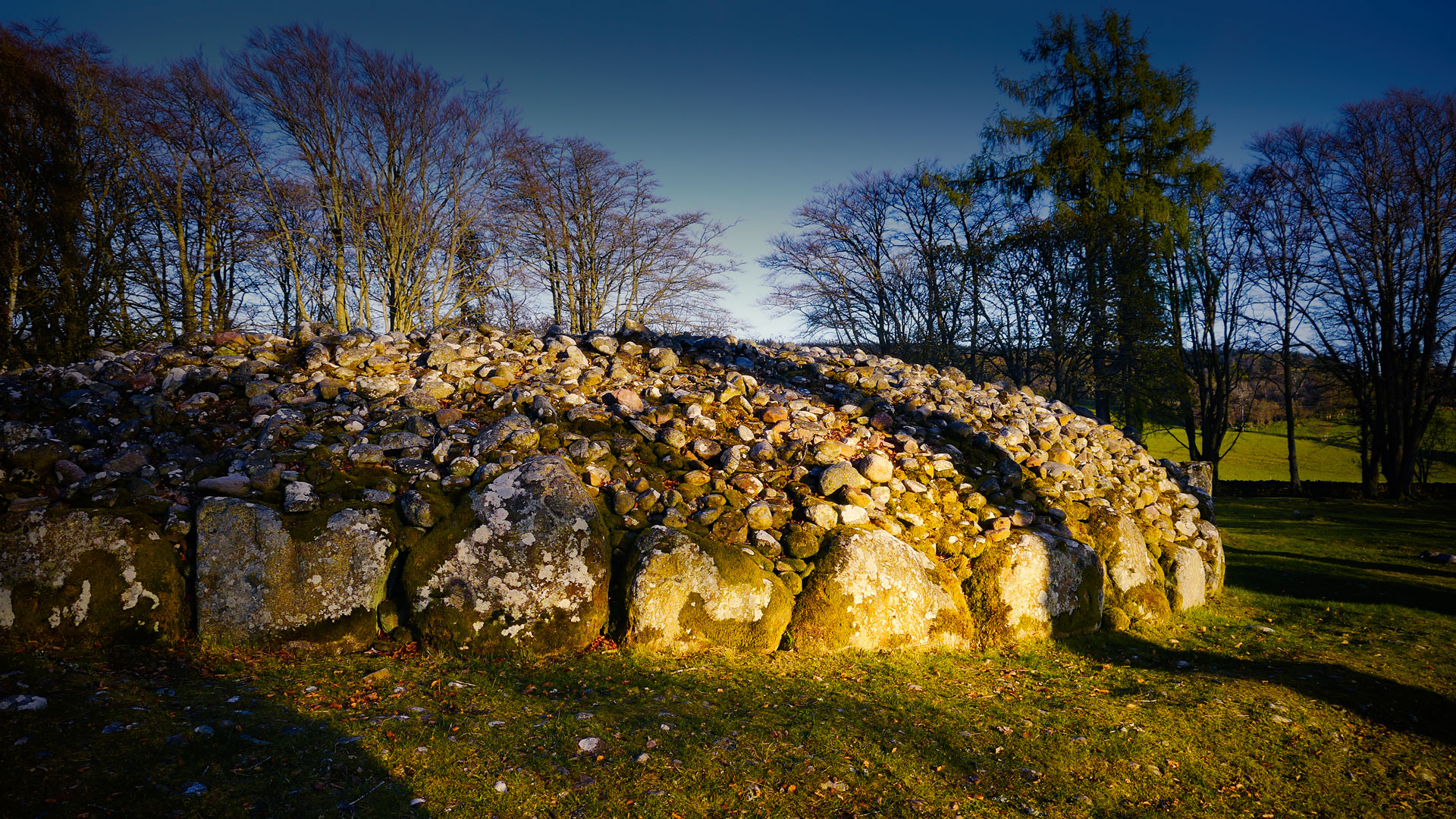
CLAVA CAIRNS
To come to Clava late is to come to it at the right time. The day has begun its long exhale, and the light, now thick and golden as mead, slants low across the Nairn valley. This is the gloaming, the edge-land of the evening, and here, among the stones, the world feels porous, its membrane thin between the present and the deep past. The shadows of the old silver birches are stretching, becoming things of substance, dark fingers reaching for the kerbstones of the cairns.
The stones themselves are not inert. They are presences, holding the memory of four thousand years of sun and frost in their granite grain. I run a hand over a kerbstone, its surface a complex cartography of lichen: rust-orange, sea-green, ghost-grey. These are the words of deep time, written in a language of slow, symbiotic growth. The cairns – what a word, from the old Gaelic carn, a heap of stones – are ring-cairns, passage graves. They are portals, built to align with a sun that has long since drifted from its celestial track, yet for a moment, as the last rays of this summer evening funnel down the stone-lined corridor of the south-westerly cairn, the ancient intention flares back into life. For a few minutes, the chamber is illuminated, a brief and sacred conversation between star and stone.
This is a place of alignments, of sightlines that track not just the sun and moon, but that connect the living to the dead. The air stills. The drone of the road back towards Culloden fades, and the only sound is the sibilance of the wind through the birch leaves and the low hum of my own attention. To stand inside the ring of stones is to feel the weight of the sky and the pull of the earth. It is not a haunting, not in the spectral sense. It is a profound sense of presence, a feeling of being witnessed by the immense span of time that these structures have anchored to this specific patch of ground.
As the sun finally dips below the hill, the light bleeds from the sky, leaving a bruised purple afterglow. The stones lose their detail and become silhouettes, their power shifting from the visual to the felt. They are markers on a ghost-road, a path walked by people whose concerns and rituals are lost to us, yet whose desire to mark the land, to speak to the cosmos, and to remember their dead, feels startlingly close. To walk away from Clava in the gathering dark is to feel the quiet resonance of their work, a stone-breath held for millennia and released into the cool night air.