CASTLE CAMPBELL
To walk Dollar Glen is to walk a cleft, a deep scour in the Ochils carved by the meeting of two waters: the Burn of Care and the Burn of Sorrow. The path clings to the gorge-wall, slick with damp, ferns uncurling from the rock-seams. You climb towards the fortress, which sits on the high, narrow tongue of land between these two ravines. Its old name, Castle Gloom, feels truer in the shadow of the glen. With me, I carry an altered eye: a camera body converted, its sensor stripped of the filter that bars the unseen. It is tuned to the spectrum of heat, to the world just beyond our given red, to the near-infrared.
The castle rises, a sudden, stern geometry of grey whin and pale sandstone against the deep, familiar green of the woodlands. I raise the camera, and the world is unmade. The click of the shutter is a door opening onto an elsewhere. On the small screen, the glen is utterly transformed, translated into a language of spectral light. This is the alchemy of the infrared, the Wood Effect: every leaf, every blade of grass, every moss-clad branch that is busy with photosynthesis explodes into a brilliant, pearlescent white. The living world, struck by the sun, reflects this other-light with a fierce luminescence, as if coated in a fresh, impossible frost.
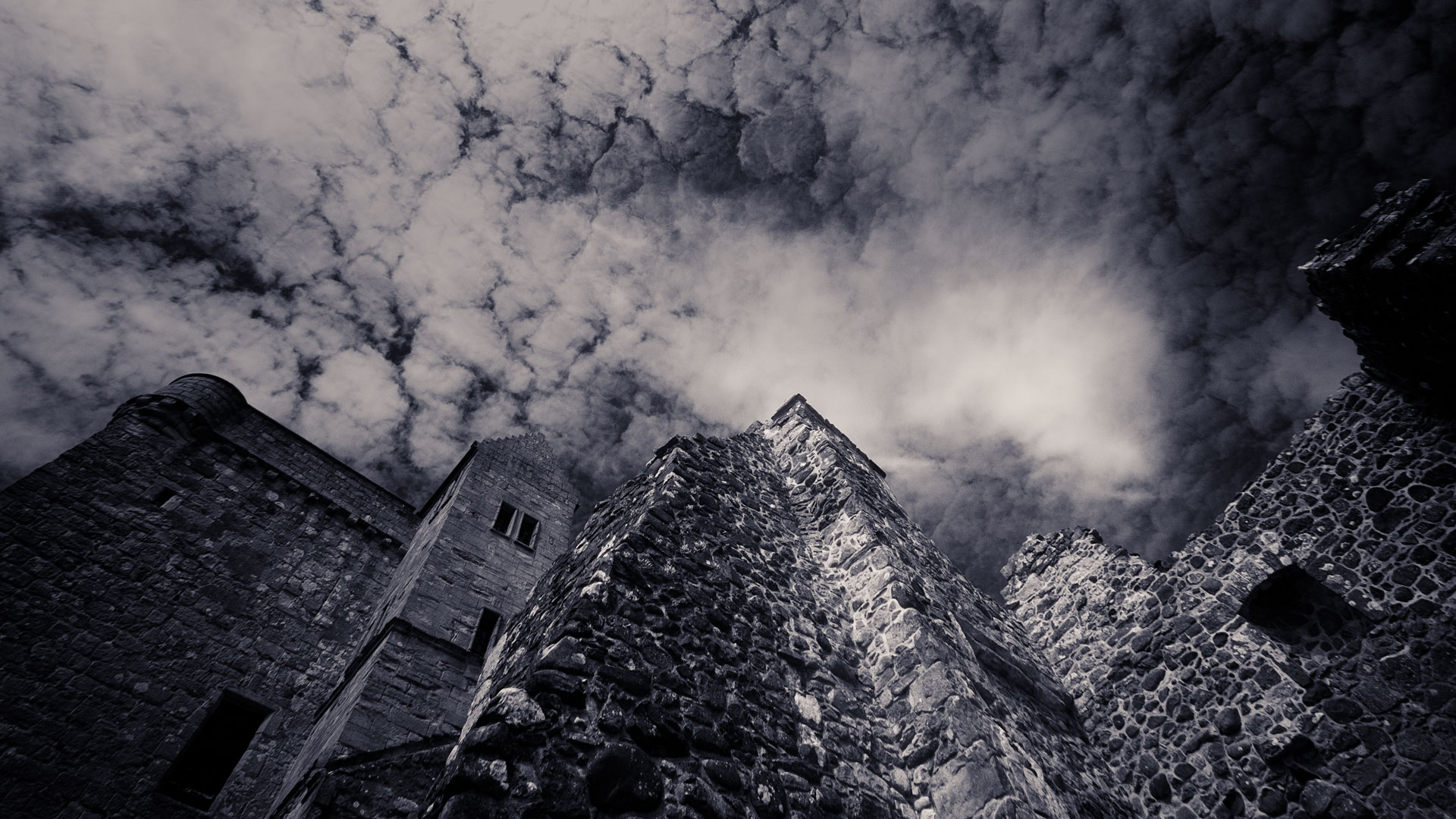
The sky, by contrast, drains of colour to become a deep, dramatic black. The castle itself, its stone inert and cold, refuses this white-fire. It remains dark, stark, a negative image etched against the spectral forest. Its masonry, its crow-stepped gables and high tower, are rendered dense and heavy, a place of pure shadow. The camera sees the dead (the stone) as dark and the living (the trees) as ghostly light. It inverts the known world, revealing the 'under-light' that seethes beneath the surface of the green.
I climb the tower's spiral stair, the stone cold under my hand, and look out from the ramparts. The view is no longer a landscape, but a map of energies. The Burn of Sorrow, far below, is a ribbon of polished obsidian, absorbing the infrared and giving nothing back. The rolling hills beyond are furred with this shining, nacreous growth. I am looking at a world that is simultaneously ancient and alien, the familiar geography of Scotland rendered as a phantom place, a liminal world where all chlorophyll is luminous and the sky is a void.
To lower the camera is a strange wrench, a re-entry. The world snaps back to its familiar palette: the soft greens, the lucid blues, the comforting grey of the stone. But the after-image lingers. To photograph in infrared is to hunt for ghosts and find them not in the stone, but in the riotous, unseen light of the living. Castle Gloom stands guard between two worlds, the visible and the veiled, and for a moment, I have seen the echo it casts in a light beyond our own.