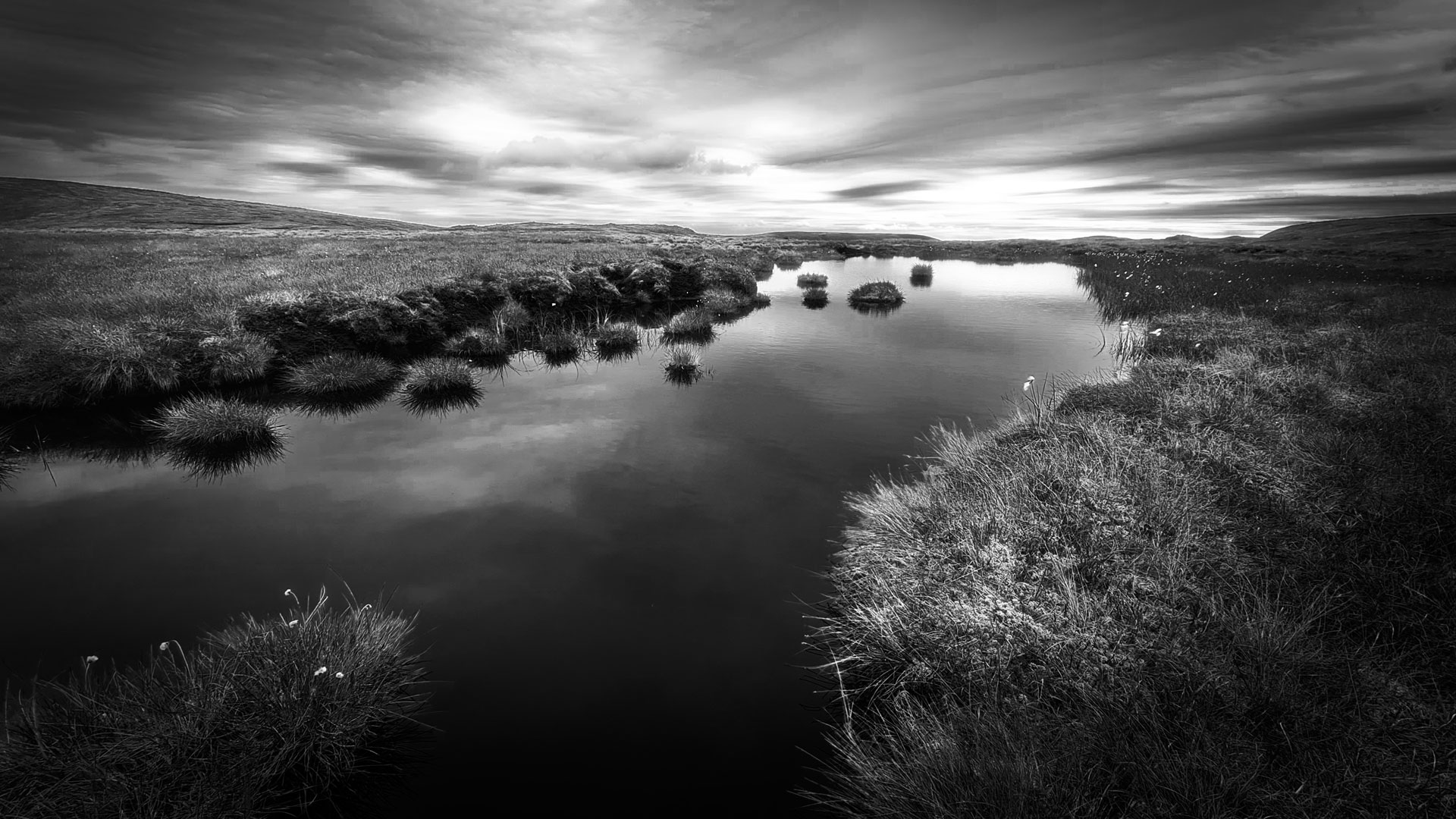
CA WHIMS
To walk the Ca Whims is to walk a map of air, a high, wind-scoured tableland whose name whispers of caprice. This is not ground that declares itself, but ground that holds itself - a vast, breathing space suspended between the granite certainties of Cairn of Claise, Tolmount, and Tom Buidhe. To be here is to be in-between, to occupy a place defined not by what it is, but by the eminences it connects. The walking is a negotiation with water and time. The boot sinks into sphagnum cushions, bright-starred and treacherous, that give way to the dark, animal-pelt of exposed peat. It is a terrain of subtle lift and fall, where the only true path is the one your body follows, led by the hollows and lines of least resistance.
The plateau holds its secrets darkly. They are the dubh lochans, the small, black tarns that pock the moraine. Dubh: the Gaelic for black, a word that carries the weight of peat-stained water and the depth of sunless ground. These are not the bright, reflective lochans of the glens. They are pupils. They absorb the light, swallowing the vast Mounth sky and giving back only a profound, geological stillness. To kneel at their edge is to feel the cold breath of the rock, to gaze into an eye that has seen the ice-scour and the slow creep of the lichen. They are basins of memory, holding the sky's reflection hostage in their dark regard.
And then, in the heart of this elemental emptiness, you find it. Two iron posts, rust-grey, lichen-fretted, leaning slightly from centuries of wind. An old abandoned gateway. There is no fence, no wall, no track that leads to or from it. It is a structure stripped of purpose, a human gesture long since undone by the elements. It stands as a pure threshold, a demarcation in the wild. It frames nothing but the heave of the land and the scudding clouds. To approach it is to feel the air charge, to sense a thinning of the veil between the seen and the felt. It is a gate, not of passage, but of perception.
I stopped, feeling the granite-grit under my boots. To step through it seemed a required act, a ritual demanded by the place. I put my hand on the cold iron - a link to the hands that carried and set it - and passed between the posts. The world on the other side was, of course, unchanged. The same wind, the same vast expanse, the same dark lochans. But I was not. By acknowledging the threshold, I had crossed one. I had stepped from one liminal space - the plateau as crossing - into another - the plateau as destination. The gateway, now functionless, had performed its greatest task. It had focused my attention, forcing me to see the land not as a void to be traversed, but as a presence to be met. It marked the boundary not on a map, but on the soul.