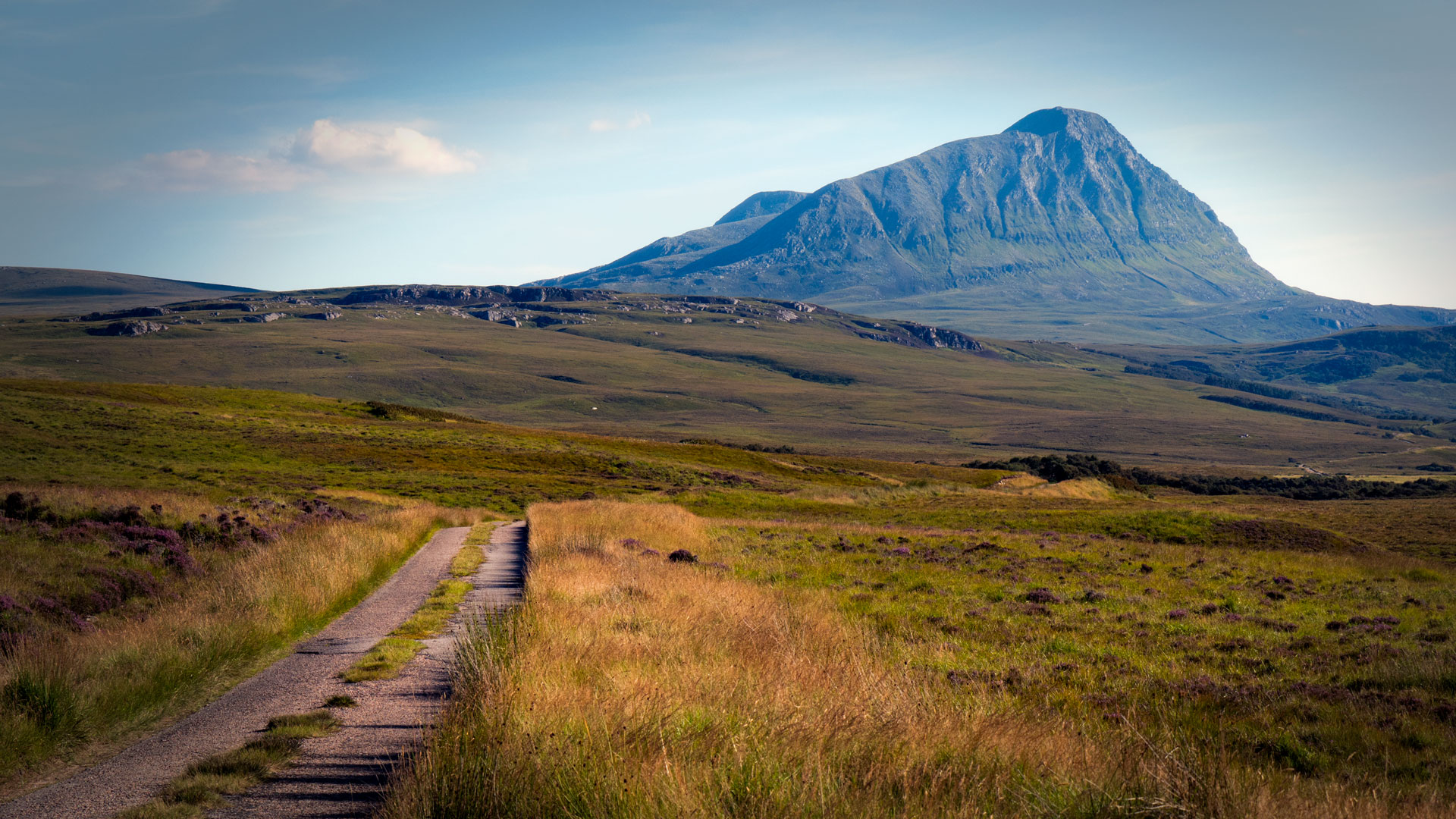
BEN HOPE
To walk up into the dusk is an inversion of the usual order of things. I leave the road late, when others are descending, their faces ruddy with the day’s work. The air by the roadside is thick with the scent of bog myrtle and the low, peaty exhalations of the Flow Country. Before me, the path up Ben Hope is a pale nerve-ending in the vast body of the mountain, a line of geological memory worn into the Moine schist by the tread of millennia. I am walking against the clock of the sun, chasing the gloaming upwards.
The ascent is a conversation with stone and gravity. My boots find purchase on the quartzite scree that glitters like crushed sugar in the last of the light. The world shrinks to the rhythm of breath and footfall, the familiar clink of trekking poles on rock. As the true dark refuses to fall, the vast landscape of Sutherland becomes a watercolour wash of indigo and grey. Loch Hope is a sheet of beaten pewter far below; the distant peaks of Arkle and Foinaven are shark-toothed silhouettes against a sky that holds a stubborn, luminous teal to the north. This is the midsummer half-light, a strange and lingering magic that belongs to these latitudes.
The summit trig point is a stark bone-white finger pointing into the spectral sky. Here, on this island in the air, I pitch my small tent, a fragile carapace of nylon against the immensity. Sleep is shallow, punctuated by the whisper of the wind against the flysheet. There is no real night, only a deep twilight, a pause in the planet’s turning. To the north, a thread of impossible orange light never quite leaves the horizon, a promise of the sun’s imminent and unconventional return.
Dawn comes not from the east, but from a place it shouldn’t be. Around two in the morning, the northern horizon begins to burn. It is a slow, silent fire, spilling colour across the clouds. Then, the sun’s rim breaches the horizon, astonishingly far to the north-east. It is a disorienting, beautiful spectacle. The light is thin and golden, casting immensely long shadows that stretch for miles, picking out the bones of the land. The world is remade in an instant: the scattered lochans become eyes of liquid gold, and the rumpled blanket of the moorland is revealed in intricate, textured detail. I am the only one here to see it, perched on this ancient stone ship as it sails into the day.
The descent in the fresh morning is a return to a different world. The mountain is now fully illuminated, its secrets laid bare by the climbing sun. I carry the memory of that strange northern sunrise with me, a secret weight of light and stone. To have slept on the summit, to have watched the sun rise from the wrong quarter of the sky, is to have stepped outside of time for a handful of hours, and to see the ancient land in a new and unforgettable light.